Testing Jev as a Review Signal for RH Skills
Three experiments tested Jev as a review signal for RH Skills. Routing fewer cases to Luna reduced modeled cost, but Jev also falsely flagged clean cases.
•By Brian Kaney
AISkillsTestingClinical InformaticsDeveloper Tools
ShareWe tested whether Jev could provide a cheap, fast review signal for RH Skills, our framework for authoring computable clinical knowledge. We wanted to learn whether Jev could identify execution records that needed a larger model's review.
Across two fresh routing experiments, the Jev-to-Luna cascade used 62.5% and 87.5% fewer Luna calls than sending every case to Luna. It matched Luna's first-pass binary defect results on each set. Jev alone also falsely flagged four of seven clean cases in the trace-derived evaluation. Those false alarms are a limitation.
The evidence supports another experiment in review triage. It does not support replacing clinical review or installing an automatic approval gate.
What RH Skills does
RH Skills is our open-source
workflow for converting clinical guidelines, quality measures, assessments,
and policies into computable content. It moves from source documents to
structured YAML artifacts that reviewers can inspect and edit, then to FHIR R4
resources and CQL. For example, a quality measure can become a structured
measure artifact before it is formalized as FHIR Measure and Library
resources with CQL logic.
Agents interpret sources, propose artifacts, and author clinical logic. The
rh-skills CLI handles file operations, checksums, workflow tracking, schema
validation, and package assembly. Reviewers approve planned work and inspect
the resulting artifacts and verification reports. That division gives teams a
way to review clinical interpretation before it becomes executable content.
Our RH Skills introduction describes the
workflow and how to get started.
Why we moved the experiment into the workflow
We initially considered Jev as another model option in rh, but it cannot
generate arbitrary CQL or TypeScript. TypeSafe describes Jev as giving up
string generation in favor of typed, probabilistic decisions.
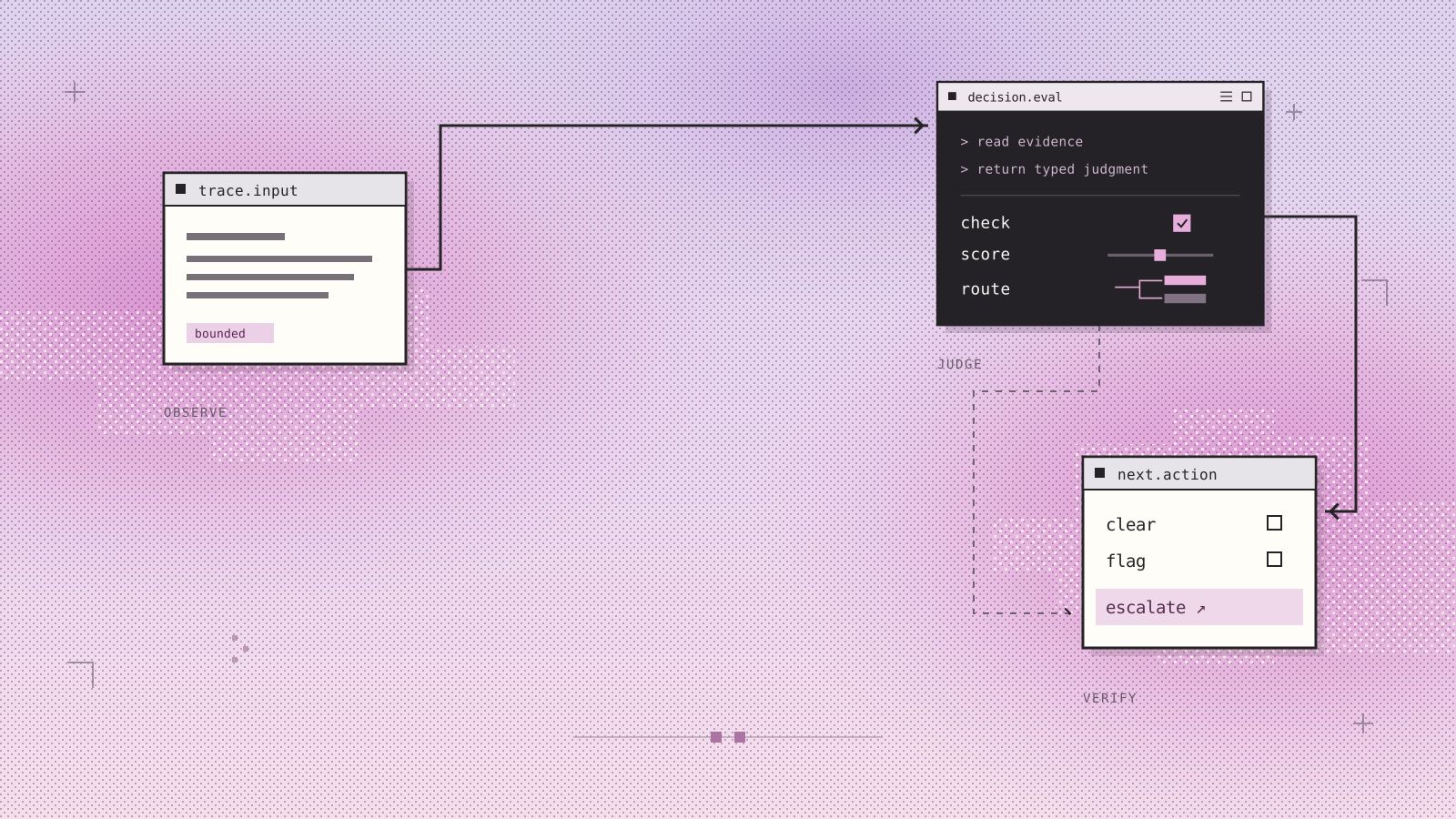
We instead tested it as a judge of RH Skills execution records, asking whether each record contained a particular defect.
We built a separate research harness outside production. It sent the same bounded evidence packet and six-question rubric to Jev and GPT-5.6 Luna. A third baseline used only the pass/fail checks recorded in the packet. The harness did not execute the underlying clinical workflow or establish the clinical correctness of its output.
| Review dimension | What the judge had to identify |
|---|---|
| Workflow violation | A required approval or CLI write boundary was bypassed. |
| Missing output | An explicitly required deliverable was absent. |
| Unsupported claim | The output added an unsupported assertion or contradicted the execution record. |
| Lost uncertainty | A qualification, exception, conflict, or unknown became a definite claim. |
| Terminology mismatch | An authorized system/code identity changed without a supplied mapping. |
| Excessive work | A successful operation was repeated without need, or the task's scope was exceeded. |
These were independent questions with explicit category boundaries. A wrong code is not automatically a missing artifact. A justified retry is not automatically excessive work. A source marked "pending authentication" is not evidence that the agent read it.
Three experiments, kept separate
We used Jev jev-1.13.0 and requested gpt-5.6-luna through the Codex CLI at
medium reasoning. Jev reported its resolved model version; the CLI did not
attest Luna's resolved snapshot. Both received the same evidence and rubric,
without reference labels, family IDs, or mutation notes.
| Phase | Evaluation cases | Where the evidence came from |
|---|---|---|
| Synthetic pilot | 12: six clean, six defective | Authored control/mutation pairs; six additional development cases. |
| Trace-derived evaluation | 16: seven clean, nine defective | Bounded excerpts and counterfactual variants from archived synthetic skill runs; eight separate development cases. |
| Continuation challenge | 16: ten clean, six defective | Eight cases derived from one archived resume-session run; eight authenticated-source simulations. No new development set. |
The trace corpus contained 24 cases from 12 archived run families before the development/evaluation split. The continuation corpus had only two correlated families. No authenticated-source transcript was available, so those cases were explicitly simulated. We did not log in to, download, or read restricted sources.
The synthetic pilot used author labels. For the later phases, a separate model reviewed shuffled, state-only packets before inference. We retained disagreements, adjudication, and ambiguity flags. These remain model-reviewed labels rather than independent human ground truth.
Each baseline ran twice. Quality below uses the first pass only; repeats measure stability and incurred usage, not additional independent examples. The initial routing analysis was hypothetical. The later cascades made fresh calls after the baseline runs, with no reused Luna answers.
The false alarms changed the interpretation
| Evaluation | Judge | Defects detected | Clean cases falsely flagged | All six labels correct |
|---|---|---|---|---|
| Synthetic | Jev | 6/6 | 0/6 | 9/12 |
| Synthetic | Luna | 6/6 | 0/6 | 11/12 |
| Trace-derived | Jev | 9/9 | 4/7 | 6/16 |
| Trace-derived | Luna | 9/9 | 1/7 | 13/16 |
| Trace-derived | Live cascade | 9/9 | 1/7 | Binary routing only |
| Continuation | Jev | 6/6 | 0/10 | 13/16 |
| Continuation | Luna | 6/6 | 0/10 | 13/16 |
| Continuation | Live cascade | 6/6 | 0/10 | Binary routing only |
FIG. 01False alarms varied by case set
Authored pilot
6 reference-clean casesJev0/6 false alarms (0%)
GPT-5.6 Luna0/6 false alarms (0%)
Trace-derived evaluation
7 reference-clean casesJev4/7 false alarms (57%)
GPT-5.6 Luna1/7 false alarms (14%)
Continuation challenge
10 reference-clean casesJev0/10 false alarms (0%)
GPT-5.6 Luna0/10 false alarms (0%)
Both models found all six planted defects in the pilot. In the trace-derived evaluation, Jev found all nine reference defects, but added 12 extra category flags and raised four false alarms on clean cases. Luna added three extra category flags and raised one false alarm. Binary defect detection was more reliable than identifying the correct defect categories.
The trace cascade inherited Luna's false alarm on a CQL fixture-readiness episode. It matched Luna's error as well as its detection result. Excluding the one ambiguous evaluation case left the same qualitative conclusion: Jev still flagged four of seven clean cases, versus one of seven for Luna and the cascade. We did not retune the policy or erase the excluded case's incurred usage.
The continuation challenge asked about valid behavior that can look like a failure: an offline fallback after a network error, preserving completed work, deferring an authenticated source, and leaving the next workflow stage for later. Both models classified all 16 cases correctly at the binary level. Both also added an incorrect category on the same three defective cases. Between repetitions, each changed one of 96 category decisions, but neither changed a binary decision.
The models and policy were unchanged between evaluations; the case mix was different. The better continuation result therefore provides no evidence of model improvement. Category scores still need validation before they can guide repairs. The continuation set contained no positive workflow-violation or terminology-mismatch examples.
Freeze the thresholds, then measure the routing
We selected thresholds using only the trace phase's development cases and froze them before evaluation. For the largest of Jev's six defect scores:
text
maximum score <= 0.25  → clear for research sampling
maximum score >= 0.90  → flag a defect
otherwise             → ask Luna
A recorded deterministic failure would take precedence; none occurred in either live cascade. The same policy was reused for the continuation challenge without recalibration. "Clear" here is an evaluation-routing decision, not permission to approve a clinical artifact or skip required validation.
FIG. 02Fewer frontier calls, shorter observed waits
Trace-derived evaluation
Luna invocations / 16 cases
Luna-only16 calls
Jev → Luna6 calls
62.5% fewer Luna calls
Observed median / seconds
Luna-only10.566 s
Jev → Luna0.447 s
Continuation challenge
Luna invocations / 16 cases
Luna-only16 calls
Jev → Luna2 calls
87.5% fewer Luna calls
Observed median / seconds
Luna-only7.566 s
Jev → Luna0.176 s
In the trace evaluation, Jev handled ten of 16 decisions without Luna; all ten agreed with the reference labels. In the continuation challenge, it handled 14 of 16 correctly, including eight clean cases. We observed no false clears in those automatic routes. With so few cases, false-clear risk remains uncertain.
The cascades made 22 and 18 total model calls, respectively: one Jev call per case, plus six or two Luna calls. Each cascade used fewer Luna calls but more total requests than Luna alone.
The observed median cascade latencies were 0.447 seconds and 0.176 seconds, versus 10.566 and 7.566 seconds for Luna alone. Baseline medians include both repetitions; each cascade ran once. Jev used direct HTTP while Luna started a fresh CLI process. These measurements include that integration overhead and network conditions. They are not an isolated inference-speed comparison or a production latency guarantee.
Repricing the recorded tokens
The original runs used an existing Codex subscription. Their attributable Luna dollar cost remains unknown. For this comparison, we applied the following Luna rates to the recorded token counts and used Jev's published input price, checked September 21, 2026. This is a modeled API-equivalent cost, not a subscription invoice.
| Model | Uncached input / 1M tokens | Cached input / 1M tokens | Output / 1M tokens |
|---|---|---|---|
| Jev 1.13.0 | $0.042 | No separate discount applied | $0 |
| GPT-5.6 Luna, comparison assumption | $0.20 | $0.02 | $1.20 |
Cached input is already included in the input count. We calculated Luna's estimate as:
text
((input - cached_input) × $0.20
 + cached_input × $0.02
 + output × $1.20) / 1,000,000
For each live cascade, the comparator is one Luna call per evaluation case from baseline repetition zero. We did not compare a single cascade pass with the cost of two baseline passes. Cascade cost includes both Jev and every actual Luna fallback.
| Evaluation, 16 cases each | Luna-only first pass | Fresh Jev + Luna cascade | Modeled reduction |
|---|---|---|---|
| Trace-derived | $0.019907 | $0.008863 | 55.5% |
| Continuation | $0.029466 | $0.004696 | 84.1% |
FIG. 03Estimated cost using recorded tokens
Trace-derived evaluation
Luna-only$0.01991
Jev → Luna$0.00886
55.5% lower modeled cost
Continuation challenge
Luna-only$0.02947
Jev → Luna$0.00470
84.1% lower modeled cost
Those percentages differ from the call reductions because the retained inputs, outputs, and cache hits differ between passes. CLI token totals include its integration context; we did not benchmark a minimized direct-API Luna client. Internal CLI transport retries are not exposed. These are estimates from the tokens we observed; savings on a larger workload would need to be measured.
The complete retained study made 154 Jev requests and 114 Luna invocations, including the earlier development smoke test, development sets, repetitions, and fresh cascades. Jev's estimated usage cost was $0.015243438. Repricing all recorded Luna tokens at the rates above gives $0.175641320, or $0.190884758 combined. That ledger counts every retained run once; it does not count reused development evidence twice or include unlogged setup probes. It also excludes engineering time and the cost of model-assisted case authoring and label review outside the measured harness.
Next steps we are considering
We are considering a shadow evaluation on complete RH Skills runs. Jev would score execution records alongside existing reviews, and we would compare its decisions with human-adjudicated labels. Its scores would be recorded without routing work or changing approval requirements.
Before deciding whether to integrate Jev, we would test:
- Performance on natural failures and ambiguous controls. Complete runs would test whether the results hold beyond selected excerpts and planted mutations.
- Sensitivity to input changes. We would vary formatting, add irrelevant context, and include instructions embedded in untrusted source material to check whether those changes alter the review decision.
- Comparison with stronger deterministic checks. Inventory, code identity, and structured approval ordering can often be checked directly. We would compare Jev with those checks before adding another model call. Our recorded-check baseline was deliberately limited; all its final checks passed in the two later corpora.
We would start with the frozen thresholds tested here and measure false clears, false alarms, Luna escalations, modeled cost, and end-to-end overhead. Those results would determine whether we add Jev as a review-triage signal, revise the routing policy, or stop the experiment.
Six detected defects do not establish perfect recall. Even an independence-based 95% Wilson interval for six successes out of six extends down to about 61%; related variants make a generalization claim weaker still. No result here validates clinical content, FHIR conformance, or executable CQL behavior.
We retained frozen inputs, source excerpts and hashes, raw provider results, model requests, label review, and routing decisions. The research suite passed 196 tests, and the new run reports regenerated byte-for-byte. The machine-readable article data contains the comparison metrics, token ledgers, pricing assumptions, and evidence hashes behind these tables and graphs. The article's cost model supplements the original results; it does not rewrite them.